
Choosing the right state to open LLC is one of the most confusing decisions new founders face. Search online and you’ll see the same answers repeated—Delaware, Wyoming, Nevada—often without context. What’s usually missing is a practical explanation of why a state works, when it doesn’t, and how real businesses operate once the paperwork is done.
After years of studying LLC formation trends and founder outcomes, one truth stands out: there is no universally “best” state for opening an LLC. The right choice depends on where you operate, how you earn revenue, and how much administrative complexity you’re willing to manage.
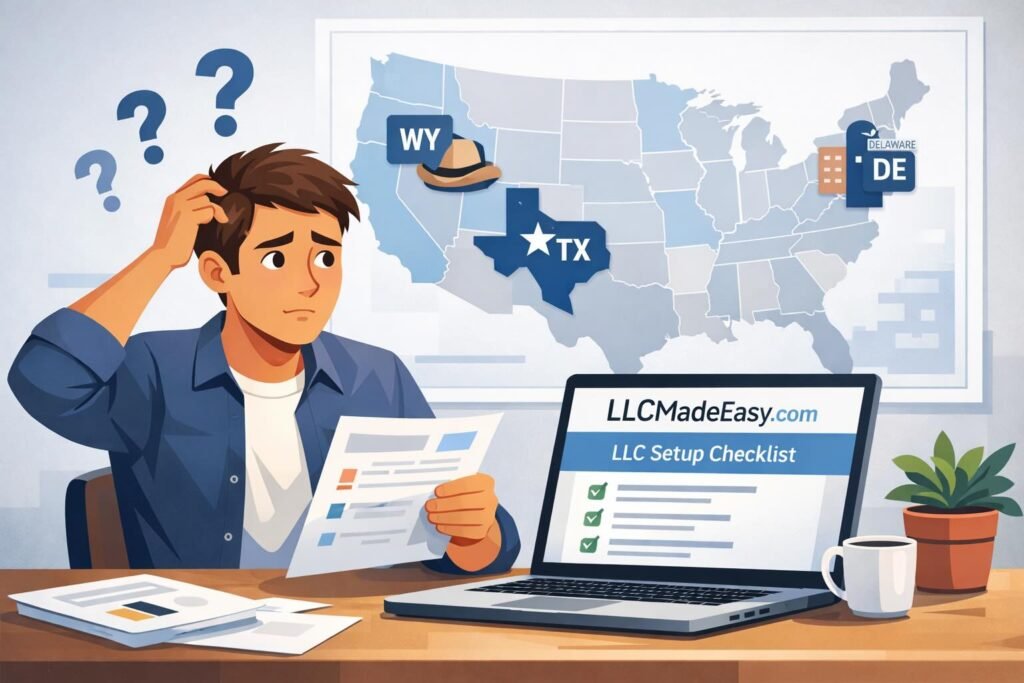
This guide breaks down the top states to open an LLC, explains the trade-offs of each, highlights common founder mistakes, and provides a clear framework to help you choose the right state for your business.
What Actually Makes a State “Good” for an LLC?
Before comparing states, it’s important to understand the criteria that matter in the real world—not just on paper.
The best state for your LLC is shaped by:
- Physical presence (where you live, work, or have employees)
- Economic nexus (where you generate revenue)
- Formation and annual fees
- State income, franchise, or gross-receipts taxes
- Ongoing compliance requirements
- Privacy and reporting rules
- Long-term growth plans
Many founders focus only on tax savings or privacy and underestimate the cost of foreign LLC registration, duplicate filings, and increased enforcement in 2025. The U.S. Small Business Administration explains how business location, liability, and operations affect where a company should be registered and when multi-state registration is required.
1. Delaware – Best for Venture-Backed and Equity-Focused Startups
Delaware’s reputation as a business-friendly state is well earned, but it’s also highly specific.
Why founders choose Delaware
- A dedicated business court system (Court of Chancery)
- Predictable legal rulings and mature corporate law
- Familiarity among venture capital firms and accelerators
Where Delaware becomes a poor fit
- Annual franchise taxes apply even to small businesses
- If you operate outside Delaware, you must register as a foreign LLC in your home state
- Added legal and administrative complexity for bootstrapped founders
Best for:
Startups planning to raise venture capital, issue equity, or scale rapidly with outside investment
For most small service businesses, Delaware’s advantages remain theoretical rather than practical.
2. Wyoming – Popular for Low Costs and Online Businesses
Wyoming has gained popularity by minimizing friction for small and digital-first companies.
Why Wyoming attracts founders
- Very low formation and annual fees
- No state income tax
- Strong owner privacy protections
The overlooked downside
- Wyoming does not replace your obligation to register where you actually operate
- Many founders end up maintaining two LLCs (Wyoming + home state)
Best for:
Online businesses, ecommerce brands, and founders operating without a physical location
Wyoming works best when your business is truly location-independent.
3. Texas – Strong for Businesses That Actually Operate
Texas rarely gets the same hype as Wyoming or Delaware, but it consistently performs well for operational businesses.
Why Texas works
- No personal state income tax
- Large customer base and workforce
- Business-friendly regulatory environment
What to plan for
- Texas franchise tax applies once revenue exceeds certain thresholds
- Reporting obligations increase as your business grows
Best for:
Businesses with employees, offices, warehouses, or customers in Texas
Texas shines when your business is built to operate—not just exist on paper.
4. Florida – Ideal for Service-Based and Remote-First Companies
Florida appeals to consultants, agencies, and remote founders.
Why founders choose Florida
- No personal state income tax
- Straightforward LLC compliance rules
- Popular with domestic and international founders
Ongoing requirement
- Annual report filing to maintain good standing
Best for:
Service providers, consultants, agencies, and remote-first businesses serving U.S. clients
5. Nevada – Privacy-Focused, Higher Cost
Nevada is often compared to Wyoming but serves a narrower audience.
Why some founders choose Nevada
- No state income tax
- Strong privacy and asset-protection statutes
Trade-offs
- Higher formation and annual fees
- Fewer advantages than Wyoming for cost-conscious founders
Best for:
Founders prioritizing privacy over minimizing expenses
6. Your Home State – The Practical Choice for Most Businesses
This is the option many founders underestimate—and the one that quietly solves the most problems.
If you live and operate in a specific state, forming your LLC there usually means:
- No foreign LLC registration
- No duplicate fees
- One set of compliance rules
- Easier banking, licensing, and insurance
- Lower risk of missed filings or penalties
Many founders form an LLC in a “popular” state, only to discover they must still register as a foreign LLC in their home state—effectively doubling costs and administrative work.
Why the Home State Wins
With increased enforcement around:
- Beneficial Ownership Information (BOI) reporting
- State compliance audits
- Sales, payroll, and economic nexus rules
Keeping everything in one primary state significantly reduces risk.
As a general rule:
If your business has a physical presence, employees, or regular operations in a state, that state is usually where your LLC should be formed.
The U.S. Small Business Administration reinforces this guidance when discussing multi-state registration requirements.
Other States to Consider (Situational, Not Universal)
Some states don’t make “top lists” but are necessary—or smart—depending on where you operate.
California
If you live or operate in California, forming elsewhere rarely avoids California obligations. In practice, forming in California is often the simplest option despite higher costs.
New York
Best for businesses with a strong local presence. Publication requirements and higher fees apply, but local formation avoids foreign registration.
Arizona & North Carolina
Often overlooked, these states offer reasonable fees and straightforward compliance for locally operated businesses.
A Common (and Costly) Founder Mistake
One of the most frequent mistakes is forming an LLC in Wyoming or Delaware simply because it’s “recommended online,” without considering where the business actually operates.
This often results in:
- Foreign LLC registration
- Duplicate annual fees
- Two sets of deadlines
- Higher risk of non-compliance
In many cases, the supposed “tax savings” disappear once real compliance costs are added.
How to Decide: A Simple Framework
Use this decision logic:
- Local operations → Form in your home state
- Remote/online business → Consider Wyoming or home state
- VC-backed startup → Delaware
- Service business → Home state or Florida
- Privacy-first strategy → Wyoming or Nevada
For federal context, the Internal Revenue Service explains how business structures are taxed nationwide.
Final Thoughts
There is no single best state to open an LLC. The right choice depends on how your business actually operates, not on online hype.
Once you choose the correct state, the real challenge becomes staying compliant year after year. LLCMadeEasy helps founders manage formation documents, filings, deadlines, and ongoing compliance in one place—so nothing gets missed as the business grows.