
Forming an LLC is often the most empowering step a small business owner takes. It creates legal separation, builds credibility, and lays the foundation for growth. But what many owners don’t realize—until they receive a penalty notice—is that forming an LLC is only the beginning. Ongoing compliance is what keeps that legal protection intact, and one of the most important recurring requirements is the LLC annual report.
After more than a decade working in the SMB and compliance space, I’ve seen this mistake repeatedly: business owners assume compliance ends once the LLC is approved. In reality, every state expects LLCs to periodically confirm their information, and missing that obligation can quietly put your entire business at risk.
This guide explains LLC annual report requirements by state, why they exist, how they differ, and how to stay compliant without turning compliance into a full-time job.
What Is an LLC Annual Report?
An LLC annual report is a state-level compliance filing, not a financial document and not a tax return. Despite the name, you are not reporting revenue, expenses, or profits. Instead, the report exists to keep the state’s business registry accurate and current.
Most states use this filing to confirm that your LLC is still active and reachable. The information requested is typically basic but legally important: your business name, principal address, registered agent details, and whether the LLC is member-managed or manager-managed. Some states also ask for the names of members or managers.
States may use different terminology—such as “statement of information” or “periodic report”—but the purpose is the same. From the state’s perspective, this filing ensures transparency and accountability for businesses operating within its jurisdiction.
Why States Require LLC Annual Reports
Annual reports are not designed to create paperwork for business owners. They exist because states rely on accurate business records for legal, regulatory, and administrative reasons.
When your LLC is in good standing, it can open bank accounts, obtain financing, renew licenses, enter contracts, and register to do business in other states. When an LLC falls out of good standing, those same activities often become delayed or blocked altogether.
In more serious cases, states may administratively dissolve an LLC that repeatedly fails to file required reports. At that point, the business technically still exists in practice—but without the legal protections that an LLC is meant to provide.
How LLC Annual Report Requirements Differ by State
There is no single nationwide rule for LLC annual reports. Each state sets its own requirements, deadlines, terminology, and fees. This is one of the main reasons compliance becomes confusing, especially for first-time business owners.
Most states require LLCs to file a report every year. Some require filings every two years instead. A small number of states do not require recurring reports at all, although other compliance obligations still apply.
This variation means that two LLCs formed on the same day—one in Texas and one in Florida, for example—will follow entirely different compliance calendars. It also means that owners operating in multiple states must track and file reports separately in each jurisdiction.
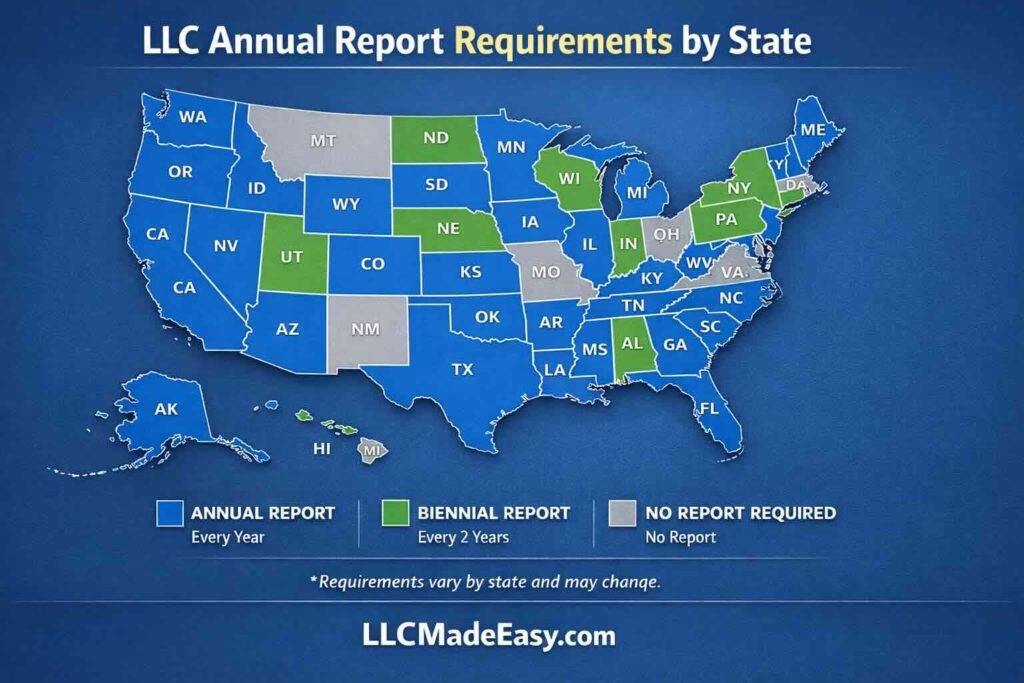
Annual vs. Biennial LLC Reports
In states that require annual reports, LLCs must file once every year regardless of whether the business earned income or remained active. These states often impose automatic late fees the moment a deadline is missed.
In biennial report states, LLCs file every two years, often based on the anniversary of formation or a designated calendar year. While this reduces filing frequency, it increases the likelihood of forgetting the obligation altogether. Missing a biennial report can result in the same penalties as missing an annual one.
The key takeaway is that frequency does not reduce importance. Whether the report is due every year or every two years, it is a mandatory compliance requirement.
Filing Deadlines and Timing Considerations
States generally set annual report deadlines using one of three approaches. Some use a fixed date that applies to all LLCs. Others tie the deadline to the anniversary of the LLC’s formation. A third group uses calendar-year or fiscal-year deadlines.
What many owners don’t realize is that states are not obligated to send reminders. Even when reminders are sent, they can be missed, filtered, or delivered too late to be helpful. Filing early is always safer than waiting until the deadline, especially since state filing portals often experience outages or slowdowns during peak filing periods.
Costs and Fees to Expect
LLC annual report fees vary widely by state. Some states charge modest fees, while others impose higher costs that can feel disproportionate for small or inactive businesses. These fees are separate from taxes and must be paid even if the LLC generated no revenue during the year.
For LLCs registered in more than one state, costs multiply quickly. Each state requires its own filing and fee, which is why understanding long-term compliance costs is essential before expanding into new jurisdictions.
⚠️ Important: The Delaware LLC “Double Filing” Trap
One of the most common and costly compliance mistakes involves Delaware LLCs.
Many business owners form an LLC in Delaware because of its reputation as a business-friendly state. However, if that LLC operates primarily from another state—such as Texas, California, Florida, or New York—it is usually required to register as a foreign LLC in the home state as well.
This creates a dual compliance obligation. The LLC must file reports and pay fees in Delaware and comply with annual or biennial reporting requirements in the state where it actually operates.
For many small businesses with no investors or physical presence in Delaware, this results in unnecessary complexity, duplicated fees, and missed filings. Understanding foreign qualification rules is critical before choosing a formation state—or after forming, if Delaware was selected by default.
How the Filing Process Works
In most states, LLC annual reports are filed online through the Secretary of State’s website. The process is usually straightforward and takes only a few minutes when your information is current.
Once filed, it’s important to save confirmation records. These documents are often required later when working with banks, lenders, investors, or licensing agencies.
Common Compliance Mistakes to Avoid
The most frequent mistake is assuming that an LLC with no income does not need to file. In most states, inactivity does not eliminate the reporting requirement.
Another common issue is forgetting about foreign LLC obligations. If your business is registered in multiple states, each state’s compliance rules apply independently.
These mistakes are rarely intentional, but the penalties apply regardless.
Staying Compliant Without Overcomplicating It
The most effective approach to LLC compliance is consistency. Setting reminders, maintaining accurate records, and filing early each year eliminates most compliance issues before they arise.
As businesses grow and expand into new states, centralized tracking becomes increasingly valuable. Treating compliance as a recurring system—not a last-minute task—protects both the business and the owner.
Final Thoughts
LLC annual reports may not feel urgent, but they are foundational. They preserve your legal protections, maintain your credibility, and keep your business eligible to operate without interruption.
For small business owners, compliance isn’t about bureaucracy—it’s about protecting what you’re building.
How LLCMadeEasy Can Help
LLCMadeEasy helps small business owners stay compliant without tracking state rules, deadlines, or filing cycles on their own. Instead of guessing when an annual or biennial report is due, you get clear visibility into what’s required for your LLC and when to take action.
By simplifying state-specific compliance into plain-English guidance and timely reminders, LLCMadeEasy reduces the risk of missed filings, late fees, and loss of good standing—so you can focus on running your business, not managing paperwork.
Where to Go Next
Now that you understand how LLC annual report requirements vary by state, the next step is figuring out which rules apply to your business and how to stay compliant throughout the year—without scrambling at the last minute.
If you’re new to LLC compliance, here’s a recommended reading path to build a solid foundation:
- Registered Agent Explained – Understand the role of a registered agent, why every LLC needs one, and how it impacts legal notices and compliance.
- Sales Tax for LLCs – Find out when an LLC is required to register, collect, and remit sales tax based on where and how it operates.
- BOI Reporting for LLCs – Learn about the federal Beneficial Ownership Information (BOI) filing requirement, who must file, and upcoming deadlines.
- LLC Compliance Checklist – A simple, year-round checklist to help you stay compliant without missing critical filings.
If you’re looking for a broader view, you can also explore our LLC Compliance Guide, which brings all ongoing federal and state compliance obligations together in one place—so you can see the full picture and plan ahead with confidence.
Legal Disclaimer
This guide is provided for informational purposes only and does not constitute legal or tax advice. LLC annual report requirements, deadlines, and fees vary by state and may change over time. Always verify current requirements with your state’s Secretary of State or consult a qualified professional.